
 EN /
CN
search the product
Search for what you are looking for here:
- Popular:EMF-SX-SOxygen AnalyzerUniMass-S
EN /
CN
Search for what you are looking for here:

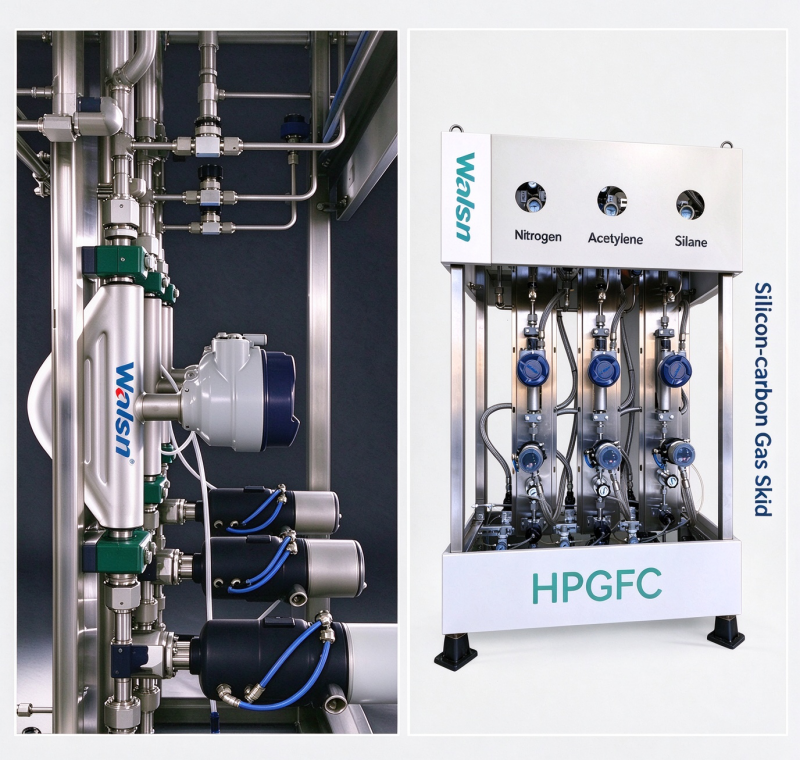
(Photo: Walsn silicon-carbon gas skid equipped with UniMass-V-3S / 4S / 5S Coriolis flowmeters)
Silicon-carbon anodes are widely regarded as the most promising next-generation anode technology for high-energy-density lithium-ion batteries. While the material offers clear capacity advantages over conventional graphite, achieving reliable mass production remains a significant challenge.
In the fluidized-bed chemical vapor deposition (CVD) carbon-coating process, the ratio accuracy and flow stability of the three process gases — silane, acetylene and nitrogen — directly determine material quality and remain a core bottleneck for many companies in mass production.
- Silane acts as the silicon source. Excess flow generates free silicon and causes particle agglomeration. Insufficient flow leaves the silicon content below target, eliminating the capacity advantage.
- Acetylene serves as the carbon source. Too much flow produces an overly thick coating that reduces specific capacity. Too little flow results in incomplete coating, leaving active silicon exposed and accelerating capacity fade.
- Nitrogen functions as both fluidizing carrier and protective diluent. Its flow rate controls particle residence time inside the reactor and therefore directly influences deposition efficiency for both silicon and carbon.
The three gas ratios are interdependent. Any drift in a single gas stream disrupts the carefully balanced ratios, leading to uneven performance within the same batch, run-to-run variation, and reduced process-gas utilization.
Conventional thermal mass flow controllers (MFCs) infer mass flow from heat transfer and are sensitive to gas composition, pressure and temperature. Prolonged exposure to silane and acetylene frequently causes crystallization, fouling, zero drift and blocked flow paths, resulting in repeated recalibration and process interruptions.
Walsn has addressed this challenge by applying Coriolis mass-flow technology to gas-phase delivery. Walsn UniMass Coriolis flowmeters measure true mass flow directly, independent of temperature, pressure or gas composition. The dedicated silicon-carbon gas skid integrates multi-line Coriolis metering, control valves, a control cabinet and comprehensive safety interlocks. Flow paths have been specifically optimized to resist fouling from silane and acetylene.
This engineering approach builds on Walsn’s proven liquid-phase skids already in use for nickel-cobalt-manganese (NCM) precursor production. Drawing on that experience, we have extended the same Coriolis-based technology to gas-phase processes. The dedicated silicon-carbon gas skid is now undergoing field trials at customer sites.
By delivering a complete closed-loop gas control solution rather than individual instruments, Walsn enables materials producers to transfer laboratory CVD processes more reliably into stable industrial production — improving batch consistency, reducing downtime and supporting the scale-up of next-generation anode materials.