
 EN /
CN
EN /
CN
search the product
Search for what you are looking for here:
- Popular:EMF-SX-SOxygen AnalyzerUniMass-S
EN /
CN
Search for what you are looking for here:

Walsn Energy Pulverized Fuel Flow Monitoring System
Precise Control of Coal Fineness to Unlock Energy-Saving Potential in Pulverizing Systems
Coal-fired power plants commonly experience high unburned carbon in fly ash and elevated pulverizing power consumption. The root cause is the absence of real-time pulverized-coal fineness monitoring. Consequently, adjustments to both pulverizing and combustion systems have long relied on operator experience, making it difficult to maintain optimal conditions:
- Inadequate control of fineness leads to significant fuel waste
R90 (residue on a 90 μm sieve) is the standard industry indicator for pulverized-coal fineness in coal-fired boilers. Based on the separator type and coal characteristics (bituminous coal, anthracite, etc.), the optimal fineness range can be precisely determined — a critical parameter for safe and economic unit operation. Most plants lack real-time fineness monitoring and therefore cannot keep R90 consistently within the optimal range specified in operating procedures. Excessively coarse pulverized coal sharply reduces furnace burnout, resulting in high carbon content in fly ash and bottom ash, substantial raw-coal waste, and lower commercial value of ash and slag for beneficial reuse.
- Over-grinding increases auxiliary power consumption
To avoid incomplete combustion, operators often adopt a “finer-is-better” approach. Coal mills and separators therefore run at high load for prolonged periods, generating considerable wasted grinding energy. Uneven air/fuel distribution in the primary air ducts further increases primary air fan power consumption, thereby raising the auxiliary power consumption rate and reducing the unit’s net power output to the grid.
Walsn Energy Pulverized Fuel Flow Monitoring System – A Precise Solution to These Challenges
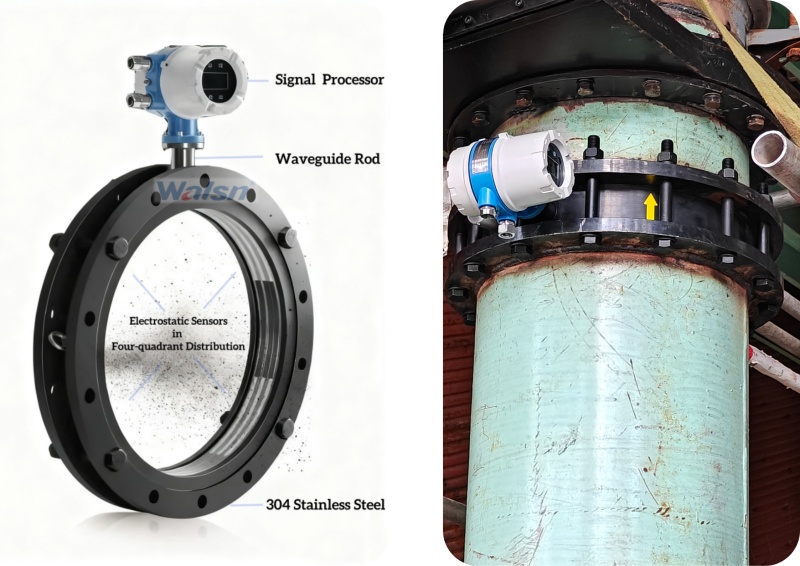
The Walsn Energy pulverized fuel flow monitoring system employs proven electrostatic coupling and acoustic emission technologies. Installed in situ on primary air ducts, it continuously measures pulverized-coal R90 fineness, velocity, and concentration in real time. By delivering continuous data that meets industry standards, the system overcomes the time lag inherent in manual sampling and laboratory analysis, enabling a shift from experience-based adjustments to data-driven precision control of pulverizing operations.
- Precise fineness control reduces coal consumption
Real-time fineness data, combined with coal quality and unit load variations, enable precise adjustment of separator speed and vanes. This keeps pulverized-coal fineness stably within the economic operating range, improves burnout, lowers combustible content in fly ash and bottom ash, reduces raw-coal consumption, and enhances ash and slag quality for higher utilization revenue.
- Optimized pulverizing operation lowers auxiliary power consumption
System data help prevent over-grinding by matching fineness to actual combustion requirements, thereby cutting unnecessary mill power consumption. Comparative analysis of air/fuel parameters across primary air ducts enables balanced flow fields and even distribution, reducing primary air fan power consumption and overall unit auxiliary power consumption rate—ultimately improving economic performance.
Product Advantages
- Fully aligned with industry standards and widely applicable
Monitoring parameters and control logic conform to general thermal power technical specifications. Data can be used directly for operational optimization, retrofit verification, and performance evaluation.
- Engineered for harsh operating conditions
Specifically designed for the high-dust, highly abrasive conditions of primary air ducts. The system provides robust anti-interference capability, superior wear resistance, and reliable long-term operation, minimizing routine maintenance requirements.
- Simple field installation with no modification to existing equipment
Requires no modifications to existing pulverized-coal piping or equipment. Quick, low-impact installation makes the system suitable for both new-build units and retrofits on existing units.
- Supports DCS interfacing for centralized, real‑time visibility
Monitoring data can be interfaced directly with the plant DCS, providing real-time display in the central control room and supporting continuous, fine-tuned operational adjustments.